
Could someone please explain to me on how to use a resistor?
Moderator: Moderators
Could someone please explain to me on how to use a resistor?
I've been researching on electronics and all that and i want to know how to calculate how strong of a resistor i need(for say an LED). i know all about Ohms law and everything but i can't find out how you would calculate a correct resistor. For example: I have a 9 volt battery and i want to connect it to a LED but i don't know the current. How would you calculate for a correct resistor. Any help would be appreciated!!!


-
S q u e e !
- Posts: 835
- Joined: Wed Feb 16, 2005 11:31 am
- Location: Lost. Are you my mommy?
Firstly, you'd have to find the current of the 9-volt using a multimeter.
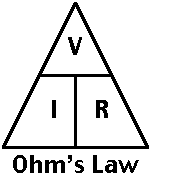
Then, using the Ohm's Law Triangle where:
E=I x R
E is EMF or Voltage, I is current (in Amps), and R is resistance in Ω.
Of course, to find out Ω, you use the equation:
R=V/I
It's quite simple really.
**EDIT**
I found this, it should help visualize.
Then, using the Ohm's Law Triangle where:
E=I x R
E is EMF or Voltage, I is current (in Amps), and R is resistance in Ω.
Of course, to find out Ω, you use the equation:
R=V/I
It's quite simple really.
**EDIT**
I found this, it should help visualize.
The VIR triangle
Ohm's Law triangle. You can use the VIR triangle to help you remember the three versions of Ohm's Law. Write down V, I and R in a triangle like the one in below.
* To calculate voltage, V: put your finger over V,
this leaves you with I R, so the equation is V = I × R
* To calculate current, I: put your finger over I,
this leaves you with V over R, so the equation is I = V/R
* To calculate resistance, R: put your finger over R,
this leaves you with V over I, so the equation is R = V/I
The Triangle
"I like my coffee like I like my women. In a plastic cup."
~Eddie Izzard
~Eddie Izzard
-
S q u e e !
- Posts: 835
- Joined: Wed Feb 16, 2005 11:31 am
- Location: Lost. Are you my mommy?


-
Life of Brian
- Moderator
- Posts: 2867
- Joined: Wed Aug 03, 2005 5:55 pm
- Location: Oklahoma
- Contact:
This is what I use: http://metku.net/?sect=view&n=1&path=mo ... /index_eng
dragonhead wrote:sweet. ive spent a third of my life on benheck!

 (Thanks for the link JoeDog but what does the desired resistance mean??)
-
S q u e e !
- Posts: 835
- Joined: Wed Feb 16, 2005 11:31 am
- Location: Lost. Are you my mommy?

-
A.J. Franzman
- Posts: 216
- Joined: Mon Jan 17, 2005 11:38 pm
- Location: La-La Land
- Contact:
Geez, you guys are so goofed up it's not even funny! (Except for joedog86 and his link.)
To calculate the value of a resistor to use in series with an LED, you need to know 3 things:
1. The voltage of the supply, Vs (volts).
2. The forward voltage drop of the LED, Vf (volts).
3. The forward current of the LED, If (amperes).
If If is in milliamperes (mA), divide by 1000 to convert to amperes (A). Thus, 75 mA = 0.075 A.
To determine the resistor value, subtract the LED voltage from the supply voltage to get the voltage across the resistor, Vr. (Vs - Vf = Vr).
Now use the "Ohm's Law" equation, converted to R = V / I. Or in this case, R = Vr / If.
Hypothetical example:
If the supply is 9 volts, the LED's forward current is 20 mA and its forward voltage drop is 3.6 volts, this gives:
9.0 - 3.6 = 5.4 volts across the resistor
R = 5.4 / 0.020
R = 270 Ω
This just happens to be exactly a standard value. However, if you used the max allowable LED current for If, and had different figures in the equation which did not result in a standard resistor value, you must go to a higher value to prevent shortening the LED's lifespan. The next common standard value is usually "close enough" - don't bother trying to put several resistors in series to make exactly the calculated value; it isn't worth the trouble.
Since littlemal didn't give us the voltage or current for his LED, we don't have enough info to calculate the resistor for him.
To calculate the value of a resistor to use in series with an LED, you need to know 3 things:
1. The voltage of the supply, Vs (volts).
2. The forward voltage drop of the LED, Vf (volts).
3. The forward current of the LED, If (amperes).
If If is in milliamperes (mA), divide by 1000 to convert to amperes (A). Thus, 75 mA = 0.075 A.
To determine the resistor value, subtract the LED voltage from the supply voltage to get the voltage across the resistor, Vr. (Vs - Vf = Vr).
Now use the "Ohm's Law" equation, converted to R = V / I. Or in this case, R = Vr / If.
Hypothetical example:
If the supply is 9 volts, the LED's forward current is 20 mA and its forward voltage drop is 3.6 volts, this gives:
9.0 - 3.6 = 5.4 volts across the resistor
R = 5.4 / 0.020
R = 270 Ω
This just happens to be exactly a standard value. However, if you used the max allowable LED current for If, and had different figures in the equation which did not result in a standard resistor value, you must go to a higher value to prevent shortening the LED's lifespan. The next common standard value is usually "close enough" - don't bother trying to put several resistors in series to make exactly the calculated value; it isn't worth the trouble.
Since littlemal didn't give us the voltage or current for his LED, we don't have enough info to calculate the resistor for him.
Last edited by A.J. Franzman on Thu Mar 09, 2006 11:23 pm, edited 7 times in total.
Mum! Dad! Don't touch it! It's EEE-VIL!
WTD: Donated dead Atari 2600 consoles, mobos, or their ICs.
2600 NTSC cartridges and manuals.
Click for TRADE/SELL and WANTED lists.
WTD: Donated dead Atari 2600 consoles, mobos, or their ICs.
2600 NTSC cartridges and manuals.
Click for TRADE/SELL and WANTED lists.
-
A.J. Franzman
- Posts: 216
- Joined: Mon Jan 17, 2005 11:38 pm
- Location: La-La Land
- Contact:
If you do that, you'll likely blow the fuse in the meter (assuming it has one, and your 9-volt battery can put out much more than half an amp into a dead short).S q u e e ! wrote:Firstly, you'd have to find the current of the 9-volt using a multimeter.
You don't need to know the supply current. You need the specified "typical" or "maximum" continuous forward current of the LED. This is not something you can measure, unless you're scavenging the LED from some other working, properly-designed circuit. This value is found in documentation from the LED maker or seller.
Mum! Dad! Don't touch it! It's EEE-VIL!
WTD: Donated dead Atari 2600 consoles, mobos, or their ICs.
2600 NTSC cartridges and manuals.
Click for TRADE/SELL and WANTED lists.
WTD: Donated dead Atari 2600 consoles, mobos, or their ICs.
2600 NTSC cartridges and manuals.
Click for TRADE/SELL and WANTED lists.