LED Fader Video
So maybe you've seen the interactive LED coffee table by Evil Mad Scientist Labs. It's an awesome project, and I'd really like to build one. Unfortunately, their DIY version is $430 for eight solder-it-yourself (SIY) panels! This is way too expensive for me, so I tried to figure out a way to replicate that effect cheaply.
Well, almost replicate it.
If you watch their video, the lights twinkle and pulse... Certainly a very nice looking effect, but really not cheap or easy because you have to program microcontrollers, and I have no experience in that.
So, I created a similar solution out of passive components.
Here is a circuit I soldered together when I was about 8:

Don't worry, my soldering is MUCH better now. But what this circuit does is make a LED light up and then dim when you touch the two protruding wires together.
That was all good, but now I need some way to activate it with a wave of my hand. I figured a dark sensor would work well for the task. After a bit of searching, I found this simple circuit on Evil Mad Scientist Labs:
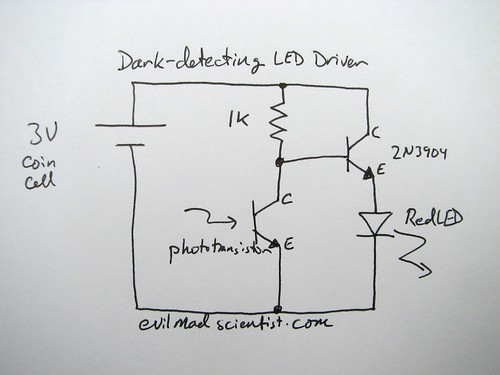
Combine the two, and you have an LED that goes full brightness then dims slowly when you wave your hand over it. In case you missed that, I mated a night light with an LED fader.
I then proceeded to make the circuit on a breadboard, which unfortunately I did not get a picture of. But, here is the finished product:


Keep in mind this is a prototype, and the CDS cell is quite insensitive. It will be replaced with a phototransistor. These are very sensitive to light (So the table can work in dimmer rooms). Now all I have to do is order a ton of parts online and make about 30 of these...
By the way, here is a schematic I drew up, in case you want to make your own: (Full version here)

The 100uf capacitor can be adjusted. If it's bigger, the LED will stay lit longer (fade slower), and vise versa.
The 47k resistor can also be adjusted. If it's bigger, the circuit is more sensitive to light (needs less light to operate). There is a limit, though, but I don't know what it is. Just don't go over 100k. If you make that resistor smaller, then you need more light.
I will post a video soon of it's operation.

